

For more information: Recommended Links | Frequently Asked Questions
Copyright © 2018 by Michael Ray Brown. All rights reserved.
“First rate analysis at a cut-rate price.”
— Creative Screenwriting



Presents
How to Plug the Holes in Your Script
“Michael Ray Brown gives you the most direct path to writing a marketable screenplay. His 18-step plan takes you from the beginning to the end of your writing experience.”
— Angela M. Cranon, publisher, Hollywood Scriptwriter magazine
Learn how to quickly analyze your screenplay in 18 crucial areas. Discover what it takes to make your script fire on all cylinders.
- Starting with theme and finishing with dialogue, this class breaks down each element of a screenplay into a series of simple questions.
- A comprehensive examination of what makes a script work, this class combines a multitude of dramatic theories into one practical guide.
- An entire screenwriting course in one class, this is a must-have guide for both novices and professionals.
- This class will arm you with all the tools you need to write an effective screenplay that is salable.
Part of the Expo Seminar Series, produced and distributed by C.S. Publications, this 2-hour master’s course is an exceptional value.

1. Theme and Meaning: Is the story relevant and easily described?
- Is the story about something?
- Does it make a statement about values or beliefs?
- Can I encapsulate it in a sentence or two (what’s commonly called a “log line”)?
- Does the subject resonate with the times?
2. Substance and Budget: Is the size and type of story suited to a feature film?
- Does the anticipated budget match the size of the anticipated audience?
- Is there enough plot material to sustain a feature film, but not too much?
- Is the story cinematic by nature, or would it be more effective as a play? As a novel? As a short story?
3. Sympathy and Empathy: Do we care about the principal characters?
- Does the protagonist draw us into the story emotionally?
- Can audiences relate to the main character’s situation?
- Is our sympathy focused on one character, and not split between two or more characters?
- Does our sympathy stay with the protagonist, and not shift to the antagonist?
4. Believability: Does the story rely on credible human efforts?
- Is the premise believable?
- Are the events believable?
- Do the characters behave realistically?
- Does the plot rely on the characters’ actions, and not on coincidence?
- Does the protagonist bring about the story’s resolution, so the ending does not rely on outside intervention?
5. Comprehension: Is the story unique, accessible to a general audience, and emotionally resonant?
- Has the story been done before? If so, have I given it a unique twist?
- Will audiences understand the language, symbols, and references in the story?
- Can audiences relate to the world depicted in the story?
- Does the story elicit universal emotions?
- Is the tone consistent?
6. Intention and Objective: Is the protagonist strongly motivated, with a clear objective?
- Are circumstances out of balance in the beginning?
- Does the protagonist have a strong motive?
- Is the protagonist’s desire to correct what is out of balance apparent within the first 10 pages?
- Is it clear within the first 30 pages (in a 120-page script) what the protagonist intends to do?
- Does the protagonist’s intention remain consistent?
- Do all the sub-intentions further the main intention?
- Does the protagonist’s intention continue to the end of the story?
7. Jeopardy and Obstacles: Is the protagonist in extreme danger of not achieving their objective?
- Have I made the protagonist’s ability to achieve their objective as difficult as possible?
- Are the obstacles credible, without seeming contrived?
- Does the effort needed to overcome the obstacles match the strength of the protagonist’s intention?
- Are there complications?
8. Conflict: Is the antagonist focused on the same objective as the protagonist?
- Are there conflicting intentions in every scene?
- Is the conflict centered on a pivotal character or object of desire?
- Is this central conflict sustained throughout the script?
- Are there conflicting psychological forces within the protagonist?
9. Anticipation and Momentum: Is there always some question that keeps the audience guessing?
- Does the central question stay the same from the beginning to the end?
- Does each scene generate anticipation for the scenes that follow?
- Do the subplots overlap sufficiently to keep the story moving?
- Does tension gradually increase?
- Are there any twists?
- Have I been careful not to telegraph the surprises?
10. Orchestration: Is there a unity of theme, represented in a variety of ways, but pulled together at the end?
- Do the events comprise a strong narrative through-line, not merely a collection of episodes?
- Is my script one movie, not two or more separate movies?
- Are there enough subplots to explore all relevant aspects of the theme?
- Is the main plot more important than any of the subplots?
- Do all the subplots serve the main plot?
- Does the pacing vary?
11. Suspense: Is the protagonist engaged in a seemingly hopeless race against time, and/or are they running out of options?
- Does the protagonist know the consequences if they fail to achieve their objective?
- Does the protagonist know the full extent of the dangers and obstacles before them?
- Does the situation appear to be hopeless?
- Does the story have either a time lock or an option lock?
12. Resolution: Does the ending restore the balance and tie up loose ends?
- Does the story satisfy the expectations set up by its premise?
- Does the dramatic highpoint occur near the end?
- Does the protagonist achieve their objective immediately after the climax?
- Does the resolution result in a new awareness for the protagonist?
- Does the resolution illustrate the theme?
- Does the ending follow naturally from all preceding events, so it does not feel tacked on?
- Is the tone of the ending consistent with the rest of the story?
- Are all the plot threads resolved, leaving no loose ends?
13. Characterization: Do the characters serve the story, and does the story derive from the characters?
- Do the characters’ actions spring from their personality and will?
- Are the characters depicted in a manner that is cinematic, not literary?
- Are the characters original, not stereotypical?
- Are the characters described in terms of their attitudes and personalities, not just their superficial traits?
- Are the characters’ traits and abilities consistent with their roles?
- Are these characters right for this type of story?
- Is each character vital to the story, with no duplicate roles?
- Do the characters have ordinary interests, hobbies, or occupations that make them seem real?
- Are there foils to contrast and balance the scheme?
- Are there bit parts to add dimension and color?
- Do the principal characters have potential for growth?
- Does the protagonist have a flaw that obstructs their efforts?
- Is the protagonist’s internal, transformational arc mirrored in their external journey?
- Does the protagonist experience a moment of self-recognition and reversal that enables them to finally achieve their objective?
14. Presentation and Point-of-view: Does the script focus on what's most important?
- Have I chosen the right places to begin and end the story?
- Have I chosen the right perspective from which to tell this story?
- Does the point-of-view originate from the character with the greatest intended empathy?
- Is the point-of-view consistent?
- Does each scene start as late as possible, rise to a climax, and end as soon as possible?
- Does every flashback, flash-forward, fantasy, and dream sequence maintain our empathy for the main character?
- Is every flashback, flash-forward, fantasy, and dream sequence adequately set up and motivated?
15. Exposition and Information: Does the script convey just enough information, but not too much?
- Have I given audiences enough information for them to understand the story?
- Is the exposition interesting and unobtrusive?
- Is every bit of information essential for telling the story?
- If critical information is being withheld for the effect of surprise, has it been done in a way that feels natural?
- Is the description cinematic, detailing only what can be seen and/or heard?
- Does the script explain all the terms and procedures that are needed for a layman to understand the story?
16. Setting: Are the time and place used effectively?
- Is the setting appropriate for this type of story?
- Is the amount of time during which the story takes place adequate to explain the amount of transformation that occurs?
- Is the progression of time and its effects realistic?
- Is the setting embellished with local color?
- Does the story take full advantage of the time and place in which it is set?
- Are the transitions from one time and/or place to another smooth and anticipated?
- Is every montage necessary, quickly advancing the story in a way that could not be achieved with traditional scene structure?
- Does the script use action, imagery, and/or sounds to convey the passage of time, without relying on superimposed legends?
- Has an expert proofread the script for anachronisms and inaccuracies?
17. Details and Picturization: Does the description lead the mind’s eye in a manner that simulates the camera?
- Is the description specific and kinetic?
- Does the script include all the details needed to tell the story?
- Do these details direct the audience’s interest in a way that seems natural?
- Is every detail relevant and necessary?
- Does every cut occur when the scene is complete, with no arbitrary intercutting just to quicken the pace?
- Is every camera movement necessary?
- Does the style of presentation suit the material?
18. Dialogue and Expression: Does every line serve the story, and is there subtext?
- Does every line flow from the characters’ intentions?
- Does every line progress the scene?
- Do the lines stay on subject? If not, is the reason for the departure apparent?
- Has the dialogue been kept to a bare minimum?
- Do the characters avoid openly stating their thoughts and feelings, thereby giving the lines subtext?
- Have dialect and slang been used to spice up the language and flesh out the characters?
- Is every instance of personal direction absolutely necessary?
Everything a Great Script Should Have
A Structure Checklist (cont’d)


Before you send your screenplay out into the world, check it against this list of what a well-constructed script should have. Of course, this is no substitute for an in-depth analysis by a professional. You may still need a script doctor, but first try this home remedy.
Screenwriting has been described as a craft, not an art. It has a strict form. Many talented writers stumble when it comes to structure, which is arguably the most important factor in a script’s success.
Fortunately, dramatic structure is something you can learn. Use this list as a guide. Check your screenplay against it. If you answer “no” to any of these questions, that’s where your script may need work.


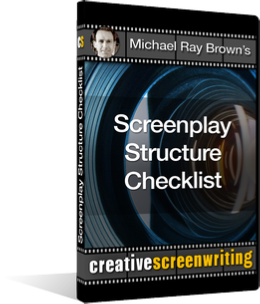
Michael Ray Brown, the founder of Story Sense, developed this list for his popular class A Structure Checklist: How to Plug the Holes in Your Script. This class is now available for purchase. A comprehensive examination of what makes a script work, it combines a multitude of dramatic theories into one practical guide.
Buy Now
| Development Notes |
| Oral Consultation |
| Studio-style Coverage |
| Selling Synopsis |
| Proofreading |
| Sample Script Analysis |
| Sample Coverage |
| Sample Selling Synopsis |
| SolPix Interview |
| Creative Screenwriting Interview |
| Scriptwriter Interview #1 |
| Scriptwriter Interview #2 |
| Scriptwriter Interview #3 |
| Scriptwriter Interview #4 |
| Elements of a Great Script |
| Margin Settings |
| Scene Headings |
| Slug Lines |
| Description |
| Character Cues |
| Dialogue |
| Personal Direction |
| Transitions |
| Flashbacks |
| Montages |
| Telephone Calls |
| Registration |
| Software |