

For more information: Recommended Links | Frequently Asked Questions
Copyright © 2018 by Michael Ray Brown. All rights reserved.
“First rate analysis at a cut-rate price.”
— Creative Screenwriting


Script Format: Transitions
Whenever there is a jump in time and/or space, we may bridge the gap by means of a transitional instruction. The transitions used most often are “FADE IN:,” “ FADE OUT.” and “DISSOLVE TO:” A common way to lead into a dream sequence, for example, is with the transitional instruction “RIPPLE DISSOLVE TO:” Some other transitions include “WIPE TO:,” “IRIS IN:,” and “IRIS OUT.,” but these are considered old-fashioned and rarely used.


The exception to this rule is any transition that ends with “IN:” For example, “FADE IN:” must be placed at the left action margin.
“CUT TO:” was once widely used to indicate the end of a contiguous sequence. In other words, when there was a break in time and/or space, screenwriters would indicate this with “CUT TO:” as a transitional instruction. That practice has fallen out of use, though, and now “CUT TO:” is considered superfluous. Unless otherwise specified, all transitions are cuts.
There is no such thing as a “SMASH CUT.” A cut is a cut. Whether it “smashes” the viewer in the face depends upon what sort of image is in the new scene.
Every transitional instruction must end with a colon. The exception is any transition that ends with “OUT.” For example, “FADE OUT.” ends in a period.
“FADE TO BLACK.” is an archaic term dating from live television. The correct cinematic term is “FADE OUT.”
As illustrated above,the use of “FADE OUT.” in conjunction with “FADE IN:” can be combined as “FADE TO:”, a single instruction that takes up less space.
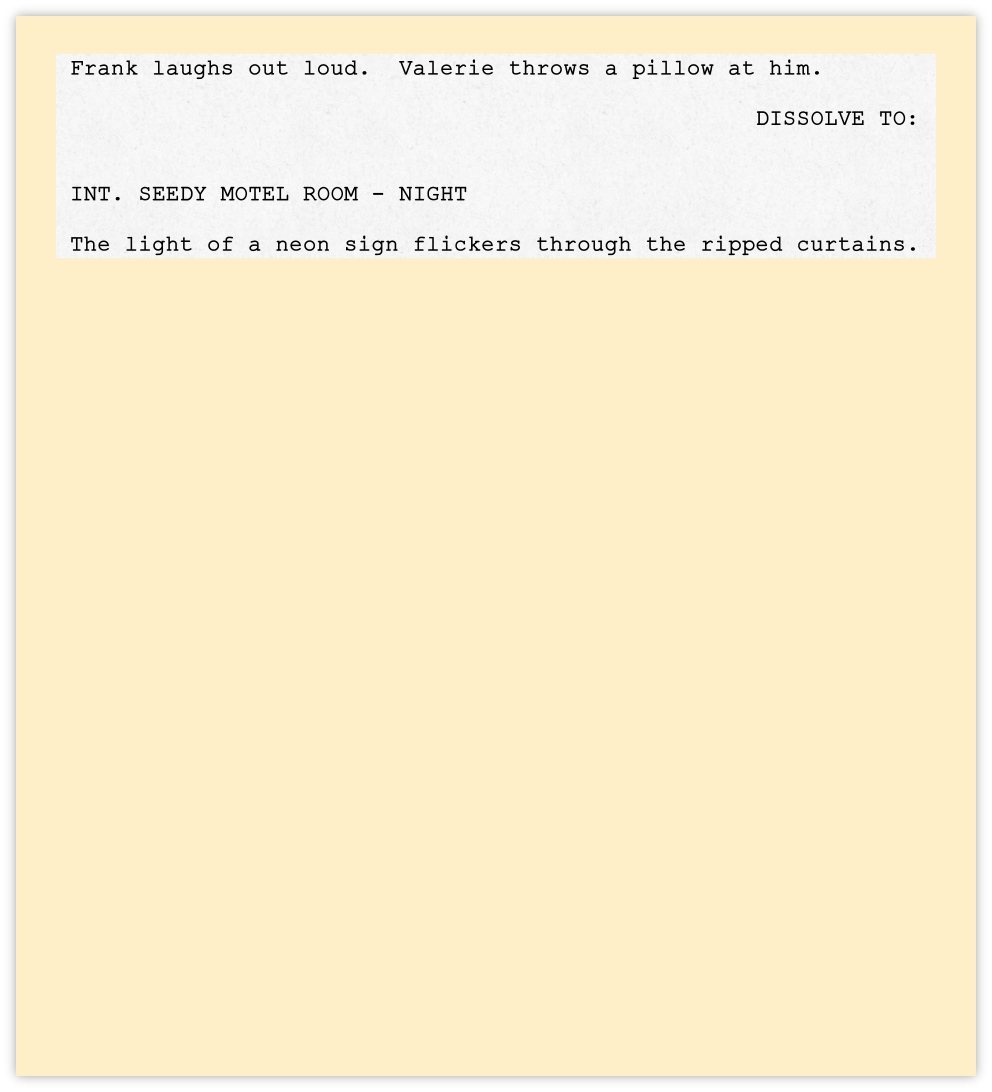
Each transitional instruction, such as “DISSOLVE TO:”, should appear at its own margin. The standard indention is 6.0 inches from the left edge of the page. In other words, the transition would begin 2.5 inches from the right edge (on paper 8.5 inches wide). It’s also acceptable for a transition to be right justified at the right margin:
 Next: Flashbacks
| Development Notes |
| Oral Consultation |
| Studio-style Coverage |
| Selling Synopsis |
| Proofreading |
| Sample Script Analysis |
| Sample Coverage |
| Sample Selling Synopsis |
| SolPix Interview |
| Creative Screenwriting Interview |
| Scriptwriter Interview #1 |
| Scriptwriter Interview #2 |
| Scriptwriter Interview #3 |
| Scriptwriter Interview #4 |
| Elements of a Great Script |
| Margin Settings |
| Scene Headings |
| Slug Lines |
| Description |
| Character Cues |
| Dialogue |
| Personal Direction |
| Transitions |
| Flashbacks |
| Montages |
| Telephone Calls |
| Registration |
| Software |