

For more information: Recommended Links | Frequently Asked Questions
Copyright © 2018 by Michael Ray Brown. All rights reserved.
“First rate analysis at a cut-rate price.”
— Creative Screenwriting


Script Format: Character Cues
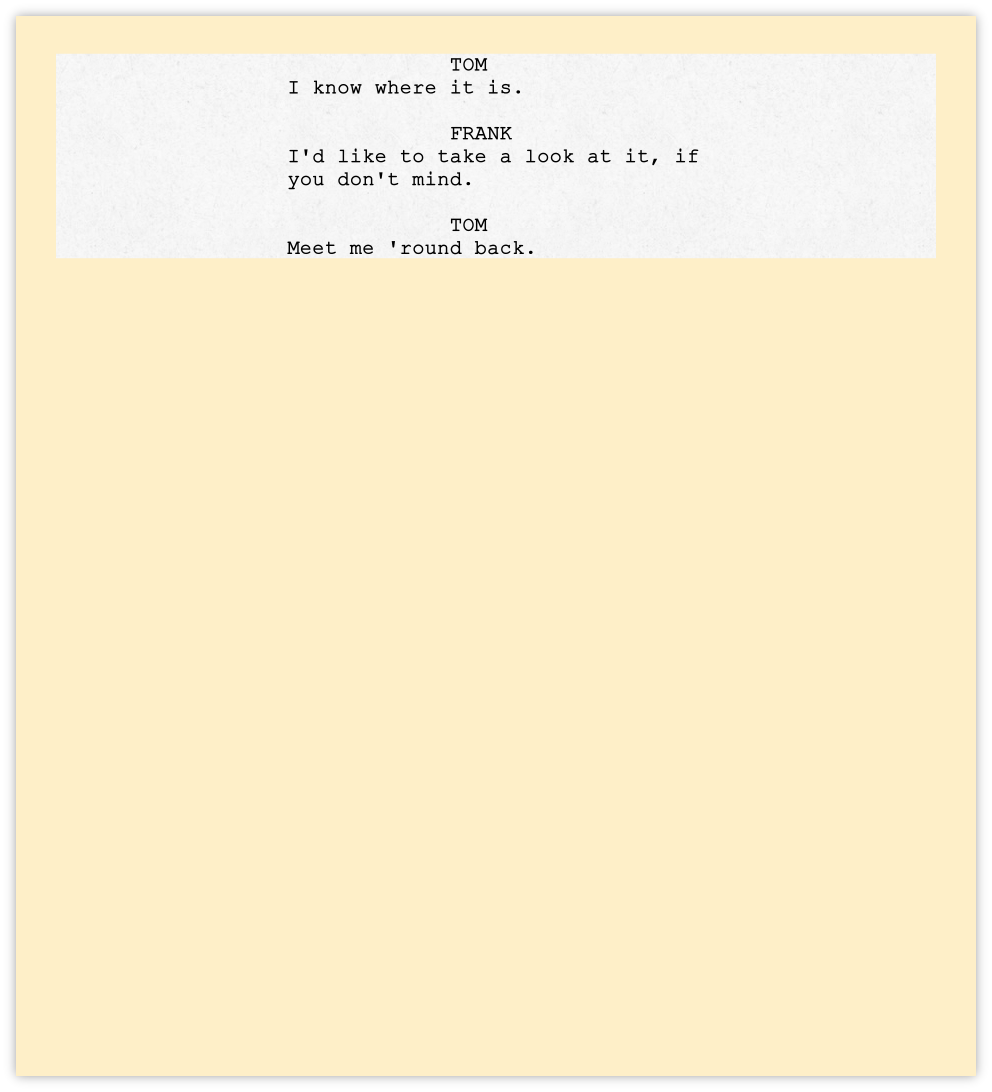
Each block of dialogue must be preceded by a cue line, identifying the character who is speaking. This character cue is always written in ALL CAPS.
Don’t center the character cues. It may look cool, but it actually makes the script harder to read. Each character cue should begin at the same column on the page (4.2 inches from the left edge being standard).
Don’t place a colon after a character cue. While some published stage plays may have colons after their cues, this is incorrect in screenplays.
It’s not necessary to use both the first and last names. Leads generally go by their first names.
When a character’s name changes, it’s customary to remind the reader of the original name by placing it in parentheses the very next time a speech is cued using the new name. In other words, if we’ve been referring to a character as DOMINATRIX, but discover her real name is MIRANDA, then the next cue for her would read:


All subsequent speeches for Miranda would be cued with just her name alone.
Never use an anonymous character cue such as “MAN’S VOICE.” Instead, identify the character by name, even if the speech originates off-screen from a character who has not yet appeared. In some situations this may spoil the surprise, but all speeches must be assigned to an actor.
Any speech from a character who is not visible should be designated as either off-screen or voice-over. Such designation is abbreviated as “O.S.” or “V.O.” written in ALL CAPS as an extension to the character cue. In other words, it should be enclosed in parentheses one space after the cue and on the same line as the cue:

When the speech comes from a character in the same setting (such as inside a closet), then “O.S.” would be used. When the character is located elsewhere (such as being heard over a telephone receiver, then “V.O.” would be used. The term off-camera (“O.C.”) is not used in screenplays, but only in three-camera television shows.
Character cues with multiple names, indicating the same line is being spoken simultaneously by more than one character, should have a slash (/) separating each name. Keep the cue as short as possible, and don’t allow it to wrap. Each cue must be limited to just one line.
 Next: Dialogue
| Development Notes |
| Oral Consultation |
| Studio-style Coverage |
| Selling Synopsis |
| Proofreading |
| Sample Script Analysis |
| Sample Coverage |
| Sample Selling Synopsis |
| SolPix Interview |
| Creative Screenwriting Interview |
| Scriptwriter Interview #1 |
| Scriptwriter Interview #2 |
| Scriptwriter Interview #3 |
| Scriptwriter Interview #4 |
| Elements of a Great Script |
| Margin Settings |
| Scene Headings |
| Slug Lines |
| Description |
| Character Cues |
| Dialogue |
| Personal Direction |
| Transitions |
| Flashbacks |
| Montages |
| Telephone Calls |
| Registration |
| Software |