

For more information: Recommended Links | Frequently Asked Questions
Copyright © 2018 by Michael Ray Brown. All rights reserved.
“First rate analysis at a cut-rate price.”
— Creative Screenwriting


Script Format: Flashbacks
Flashbacks and dreams place us in the mind of the character who is relating them. This causes us to identify with that character, drawing us into their story. Unless that character is our main character, though, our empathy will be split, and the dramatic force of the narrative weakened.
Flashbacks interrupt the narrative flow. Consequently, they should be used only when it is not possible to tell the story chronologically. Don’t use a flashback to merely to illustrate what a characters is relating verbally. It is often more effective to remain focused on the character who is recalling a particular event, so as to gauge what that memory means to them.
If you use flashbacks, make certain they are motivated. Lead into the flashback by focusing on the character who is experiencing it, and then return to that same character after the flashback. The events may not be as significant as how the character feels about them. Consequently, it is essential that we see the character’s reaction.
If the flashback consists of only one scene, it’s acceptable to simply write “(FLASHBACK)” as the last part of the scene heading:
The same applies for dream and fantasy sequences.
 Next: Montages


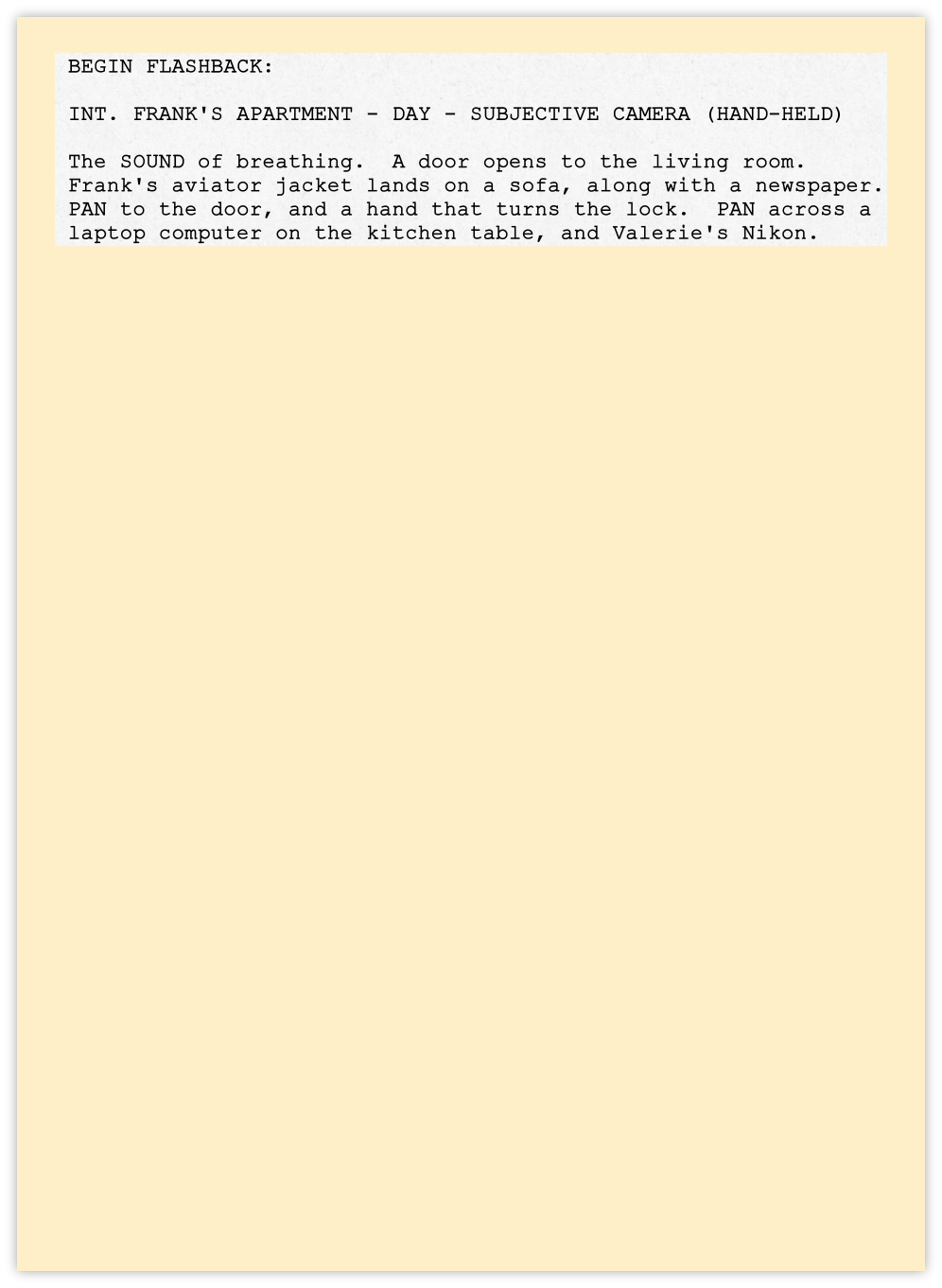
The proper technique for taking us into a flashback sequence is to insert the line “BEGIN FLASHBACK:” (in ALL CAPS and without the quotes) formatted as an action element. There should be only one blank line between this and the heading of the first scene of the flashback:

The spacing before “BEGIN FLASHBACK:” is the same as the spacing before a scene heading. If you triple-space (two blank lines) before each scene heading, you also must triple-space before “BEGIN FLASHBACK:”, and double-space (one blank line) after it. Unfortunately, if you enter “BEGIN FLASHBACK:” as an action element, there will be only one blank line above it, and two blank lines below it. This means that, if you triple-space your scene headings (the preferred spacing), you must “cheat” the spacing before “BEGIN FLASHBACK:” as well as the spacing before the scene heading which follows it.
Each scene in a flashback must have its own heading, even if it occurs in the same setting as the character who is experiencing the flashback.
Another action line takes us out of the flashback with the words “END FLASHBACK.” (The period should be included.) It would be incorrect to insert the slug line “BACK TO SCENE” because the flashback is the scene. We must instead follow the flashback with a new scene heading, even if we are returning to the same place we were prior to the flashback (which usually is the case):

| Development Notes |
| Oral Consultation |
| Studio-style Coverage |
| Selling Synopsis |
| Proofreading |
| Sample Script Analysis |
| Sample Coverage |
| Sample Selling Synopsis |
| SolPix Interview |
| Creative Screenwriting Interview |
| Scriptwriter Interview #1 |
| Scriptwriter Interview #2 |
| Scriptwriter Interview #3 |
| Scriptwriter Interview #4 |
| Elements of a Great Script |
| Margin Settings |
| Scene Headings |
| Slug Lines |
| Description |
| Character Cues |
| Dialogue |
| Personal Direction |
| Transitions |
| Flashbacks |
| Montages |
| Telephone Calls |
| Registration |
| Software |